What’s Going on in the Canadian Economy Right Now?
As 2025 wraps up, Canada’s economy is ending on a stronger-than-expected note, but there’s no denying the uncertainty ahead. Trade tensions, cautious consumers, and lagging investment are setting the stage for a slow-growth 2026. While AI and defence spending offer long-term promise, risks remain high heading into the new year.
A Mixed Economic Picture
Canada’s GDP grew 2.6% in Q3 2025, higher than expected, largely thanks to an 82% surge in defence spending (Benchetrit, 2025). This helped offset soft household spending and stagnant business investment, allowing the country to narrowly dodge a technical recession.
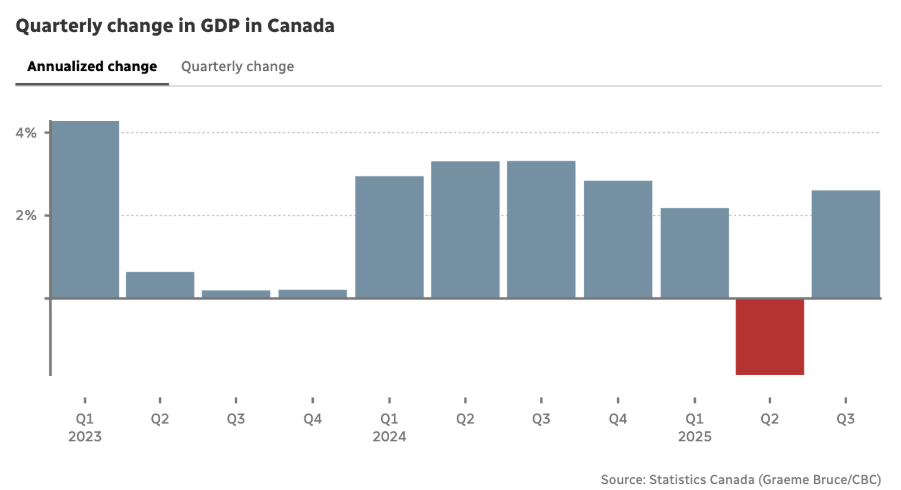
While global growth surprised to the upside in 2025, TD Economics notes that Canada’s economic outlook remains more muted. Unlike the U.S., where fiscal stimulus is supporting momentum, Canadian GDP growth is likely to remain sluggish near 1.0% in 2026 due to investment hesitation tied to trade uncertainty (TD Economics, 2025).
According to the Business Development Bank of Canada, 2026 can expect a 2.0% inflation rate and an 3.0% average wage growth. Despite the headwinds, Canada’s job market remains resilient. Employment rebounded in late 2025, with 180,000 new jobs added in the last three months, pushing the unemployment rate down to 6.5% (Cléroux, 2025).
Trade, Tariffs & the USMCA Uncertainty
One of the biggest wild cards for 2026 is the scheduled review of the U.S. – Mexico – Canada Agreement (USMCA) in July. With trade tensions already pressuring exports, steel, aluminum, and autos all declined in 2025, businesses remain cautious about future investment (Cléroux, 2025).
Scenarios range from a modest revision of the agreement to a full withdrawal by the U.S. administration. Either outcome could have lasting impacts on Canadian industries, especially manufacturing and agriculture (Lundy & Kirby, 2025).
Canada’s continued dependence on the U.S. market (where nearly 75% of exports go) makes the outcome of these talks especially significant. While efforts are underway to diversify exports to Europe and Asia, progress is expected to be gradual (Lundy & Kirby, 2025).
Government Spending & Investment as Stabilizers
Governments at both the federal and provincial levels are expected to be key drivers of economic stability in 2026. The 2025 federal budget outlined billions in capital investments, with defence, infrastructure, and AI modernization taking centre stage (Leach, 2025).
While planned deficits remain elevated, projected at 3.5% of GDP in 2025–26, the actual spending rollout has been slower than expected. This may result in lower-than-forecasted deficits and delayed stimulus pushing into late 2026 (Leach, 2025).
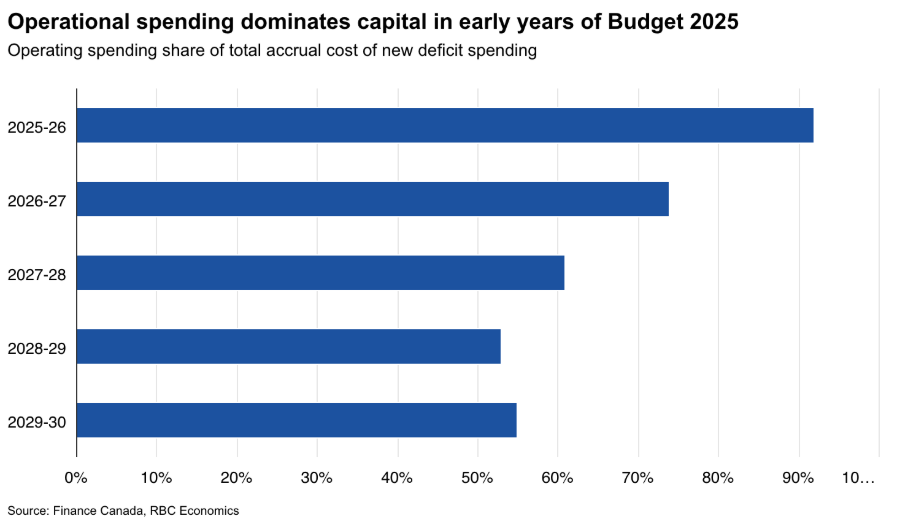
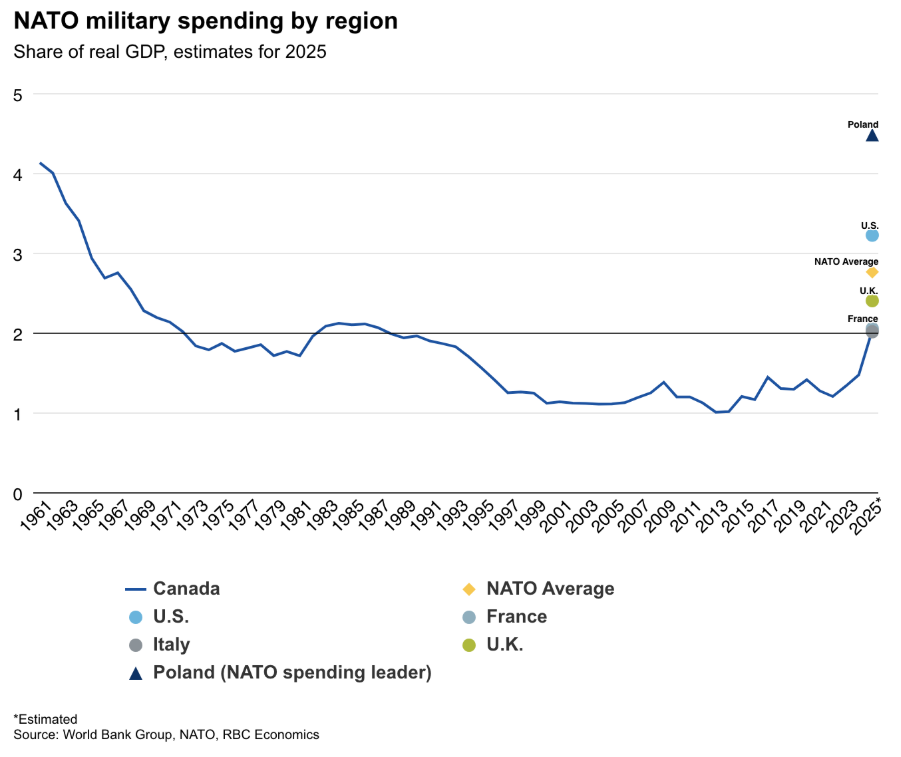
Meanwhile, the new Defence Investment Agency, will boost Government spending by $150 billion to 5% of GDP by 2035, with hopes to fuel domestic procurement and manufacturing (Lundy & Kirby, 2025). TD Economics highlights the role of large-scale infrastructure and defence spending as a key buffer in 2026. However, execution remains a risk as many of the announced projects are still in the planning phase and may not provide an immediate boost to growth (TD Economics, 2025). The same caution applies to the Major Projects Office, which some critics see as more branding than action. While projects like the Port of Montreal expansion and mini nuclear reactors in Ontario signal a longer-term pivot toward economic transformation (Cléroux, 2025).
Business Investment & Sector Risks
Businesses continue to face cost pressures from tariffs, a weaker Canadian dollar, and persistent wage growth due to labour shortages (Cléroux, 2025). While some sectors, such as defence, infrastructure, and AI, stand to benefit from public investment, others remain cautious.
The manufacturing sector, for instance, is vulnerable to policy changes, especially if the U.S. expands tariffs or redefines content rules under USMCA. Energy and critical minerals may also see renewed interest, but permitting and political friction could slow progress (Lundy & Kirby, 2025).
Several CEOs warned that soaring construction costs and stagnant productivity are deterring investment. Jimmy Jean, Chief Economist at Desjardins, noted that Canada’s construction productivity is flat compared to 25 years ago, despite rising wages, driving up project costs across the board. This raises barriers to private investment in both housing and industrial expansion (Johnson, 2025).
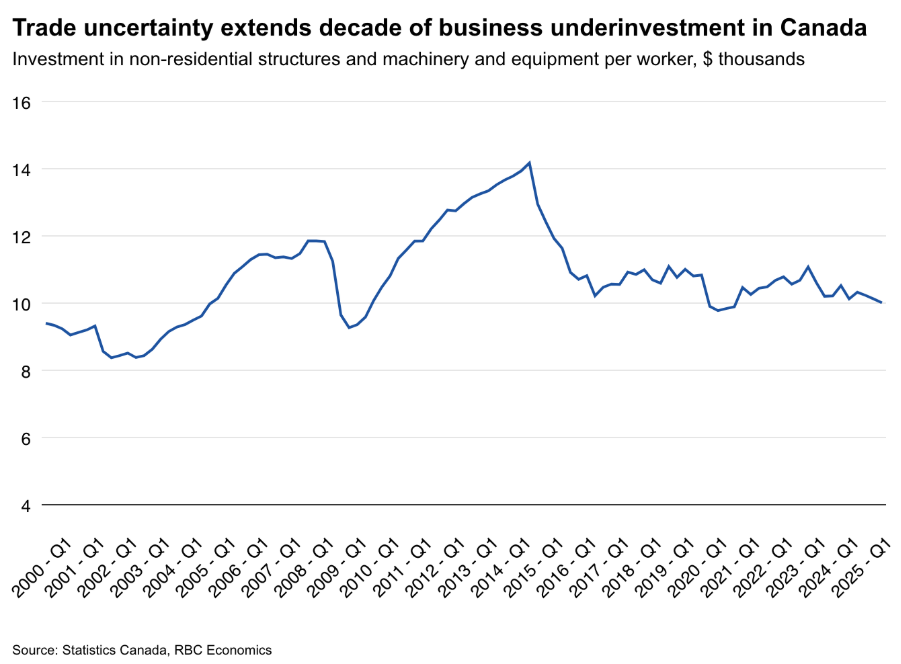
RBC’s data shows a sharp gap between investment intentions and execution in 2025, especially in non-residential sectors. A key theme was hesitation, as firms had cash, but held back on spending amid rate uncertainty and trade risk. The below chart illustrates how business investment stagnated despite large government capital allocations (RBC Economics, 2025).
What This Means for Your Financial Plan
As we close out 2025, it's a great time to reflect on your finances:
- What were your wins this year?
- What challenges did you face?
- What do you want to focus on in 2026?
Maybe you’re hoping to max out your TFSA, buy life insurance, pay down debt, or just eat out a little less often. Whatever it is, getting clear on your priorities now can help you step into the new year with purpose.
Even in uncertain times, a thoughtful financial plan gives you something steady to rely on. As you look ahead, keep these three things in mind:
1. Flexibility Is Your Friend
With trade uncertainty and shifting economic conditions, having a plan that can adapt, like keeping some extra savings or reviewing your investment mix, is more important than ever.
2. Small Tweaks, Big Impact
You don’t need a total overhaul. Whether it’s increasing your RRSP contributions, reviewing your budget, or checking in on your insurance, small adjustments can really move the needle over time.
3. You’re Not Alone
If you’re unsure where to start or feel like your finances need a refresh, reach out to your financial advisor. They’re there to help you align your goals with a plan that actually works for your life.
Whether you're a current client or someone looking to take the next step toward financial success, Alpen Investment Advisors is here to guide you every step of the way. Based in North Vancouver, our team, led by Jon Alpen, brings over 18 years of experience in helping clients grow, preserve, and navigate their wealth. With expert guidance, tailored solutions, and a steadfast commitment to your success, we are dedicated to supporting your unique financial journey.
Reach out to us today at jonathan@alpenia.ca to start or continue building your financial future with confidence and clarity.
References
Benchetrit, J. (2025, November 28). Canada’s economy grew at an annualized rate of 2.6% in 3rd Quarter . CBC News. https://www.cbc.ca/news/business/canada-gdp-q3-2025-9.6995959
Cléroux, P. (2025, December 15). Canada 2026 Economic Outlook. Business Development Bank of Canada. https://www.bdc.ca/en/articles-tools/blog/canadian-economic-outlook-for-2026
Johnson, D. (2025, December 22). Gold prices lift S&P/TSX composite, U.S. stock markets also rise. City News . https://halifax.citynews.ca/2025/12/22/sp-tsx-composite-up-nearly-300-points-u-s-stock-markets-also-move-higher/
Leach, C. (2025, December 18). Canadian fiscal: Will better growth, delayed spending soften deficit blow?. RBC Economics. https://www.rbc.com/en/economics/canadian-analysis/featured-analysis/insights/canadian-fiscal-will-better-growth-delayed-spending-soften-deficit-blow/
Lundy, M., & Kirby, J. (2025, November 28). Economic outlook 2026: The good, the bad and the downright scary. The Globe and Mail. https://www.theglobeandmail.com/business/rob-magazine/article-economic-outlook-2026-trade-housing-artificial-intelligence/
RBC Economics. (2025, December 22). Eight charts that defined Canada’s economy in 2025. https://www.rbc.com/en/economics/canadian-analysis/featured-analysis/insights/eight-charts-that-defined-canadas-economy-in-2025/
TD Economics. (2025, December 11). Canadian Quarterly Economic Forecast. TD Canada Trust. https://economics.td.com/ca-quarterly-economic-forecast